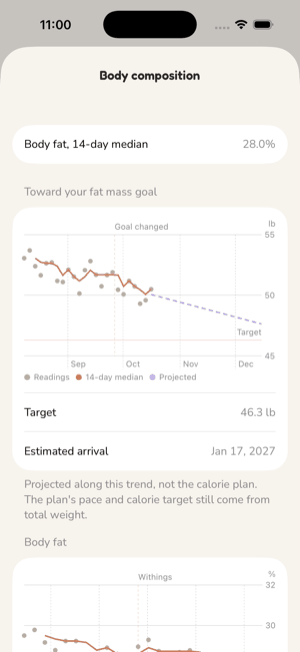
The app keeps one weigh-in per day and, when a scale reports it, one body
composition reading per day. Composition is read as a trend, never as a single
number, and it never changes the calorie budget.
Weigh-ins
Type one from the Diary's weight card or the Progress
tab. A typed weigh-in wins its day: nothing read from Apple Health replaces
it, whenever it was made.
Or connect a scale. Progress › Weight connects Apple
Health. The app reads weight samples written by other sources (a smart
scale, another app) and ignores its own. If a scale's reading is in Health
but not here, see the read
permission note.
One reading stands for a day. A scale often writes
several samples a day. The one kept is the earliest between 04:00 and 11:00
local, after waking and before food, the most comparable reading from one
day to the next. If there is none in that window, the earliest of the day.
Samples are never averaged: a morning and an evening reading are not two
measurements of the same thing.
Health days follow the pick. A day the app only knows
from Health is updated if a different sample becomes the day's pick. A day
with nothing gets the pick.
Typed weigh-ins go to Health too, replacing only what
this app wrote for that day. A scale's reading for the same day is not the
app's to remove. Deletions do not propagate in either direction: this is a
merge, not a mirror.
Pulled on every foreground. Opening the app checks
Health for new weigh-ins and composition readings.
The newest weigh-in becomes the profile weight the
budget and the protein target are computed from.
The weight chart projects forward up to 60 days from the plan's daily
energy gap, at 7,700 kcal per kilogram. A deficit clamped by the safety floor
projects the smaller, honest rate. The horizon stays short because real
trajectories flatten as maintenance falls with weight.
Body composition
Body fat percentage and lean body mass arrive through the same Health
connection as weight, read-only. The app never writes either anywhere. For
each day:
The day's body fat and lean mass samples are picked by the same
morning-first rule as weight.
Body fat is stored as a percent (28.4), not the fraction Health uses,
and it is the source of truth: the headline number, the one a goal keys
off, the one the scale's own app shows.
One weight governs the row. It is the scale's own
weight sample from the same scan (same source, within a minute of the
composition sample), or else that day's weigh-in. Fat mass is weight ×
body fat; lean mass is weight minus fat. The three figures on a row
therefore always add up, which the scale's own numbers did not: its
percent is rounded to a tenth, and its lean figure disagreed with it by
grams.
The lean mass the scale reported is kept on the row for the record but
never shown, and the row is flagged when it differs from the derived lean
mass by more than 50 g. Without any weight for the day, the percent is
stored alone; a mass is never a guessed zero.
The trend
The headline is the median reading of the last 14 days.
The readings in the window are sorted by body fat percent and the lower
middle one is taken, so the body fat, fat mass and lean mass shown together
always come from one real measurement rather than three medians of three
different days. The screen names that reading's date. A single bioimpedance
reading swings with hydration, time of day, food and training; there is no
headline at all until three readings sit in the window.
The chart draws the median at each reading's date and
ends at the last reading. Nothing is drawn forward of what was measured.
Stale after 14 days. A newest reading older than that is
shown with its date, there is no median, and the trend stops there. Say
what you know and when you knew it.
Change is shown since the first reading and against the
reading nearest 30 days back, as numbers. Whether a direction is good is
your reading, not a colour the app applies.
A new scale is marked. A reading whose source differs
from the one before is a legitimate step in the trend, and the chart says
so rather than hiding it.
What composition never does
The calorie budget is computed from total weight only. Body fat and lean
mass do not enter it, because nobody can choose to lose fat specifically; the
pace and the deficit are set against the scale. What composition can do is
become the number your goal is measured against, once there are three weeks
of readings. See Goals.